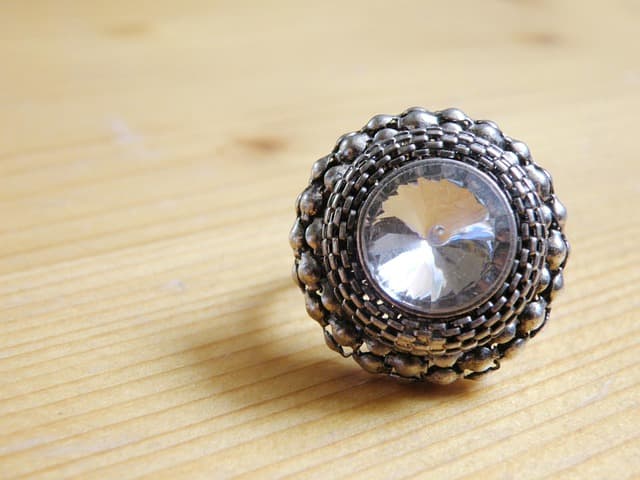
Tungsten, or more precisely tungsten carbide, is a beautiful and durable material, but that is not all there is to say about this unusual metal.
Tungsten metal
Tungsten has only recently begun to be used in jewelry, but it has already won over the public with its extraordinary strength and wear resistance. But is this unusual metal really “eternal,” and should it be preferred over silver and gold? Let’s take a closer look.
Properties of tungsten carbide
Tungsten metal was discovered in 1783 and is mainly used in industry. Tungsten is extremely hard, and its density is twice that of lead. When combined with carbon, the metal turns into tungsten carbide: a material comparable in hardness to diamond, wear-resistant and almost impervious to oxidation. According to Mohs, its hardness reaches 8.5-9 units.
Among other metals used in jewelry production, the closest to it is titanium carbide, an alloy of tungsten and titanium, which boasts a Mohs hardness of 7.
As a result, tungsten carbide, in addition to being used in the manufacture of cutting tools and projectile cores, has also found its way into jewelry.
The main reasons for tungsten’s popularity are its durability and resistance to deformation. Even after many years of wear, the product does not show any scratches or cracks, and the jewelry retains its original shape. In addition, one should not forget about another important and valuable quality of this metal: tungsten rarely causes allergies, which allows almost everyone to wear it without exception.
Incidentally, another extremely wear-resistant material for jewelry production is ceramics. Quite a few global brands have joined the trend and presented their own ceramic products: watches, rings, pendants, etc.
The noble shine of tungsten
Tungsten jewelry, most often rings, is especially popular with men. They are durable, and their steel shine is elegant and unobtrusive. In addition, such products are considered self-polishing.
Tungsten jewelry can be given an additional coating. For example, a zirconium coating gives the finished product a golden tone, ion deposition blackens the jewelry, and a silver tint is natural for tungsten. The latter fact allows tungsten to compete with silver, platinum, and white gold.
Women’s tungsten jewelry is preferred by confident girls. It is not easy to combine such jewelry with other items; it requires an extraordinary sense of style. However, a tungsten ring or bracelet does not need to be paired with other jewelry — such jewelry looks impressive and complete on its own.
Various stones are also inserted into tungsten jewelry and covered with engravings. However, all of this is done in a manufacturing setting. In a simple jewelry workshop, it is not possible to reduce or enlarge a tungsten ring, repair a bracelet clasp, or apply an engraving. Being a very hard and dense material, tungsten requires special equipment and tools.
Use in jewelry
Tungsten was first used outside of industrial and military applications less than ten years ago — in Swiss watch bracelets. The pure shine, noble silver hue, and physical characteristics of this unusual material won over jewelry connoisseurs.
Today, tungsten is an effective alternative to gold, silver, and platinum, as these precious metals are much softer and easily damaged when worn as jewelry.
Many jewelry brands now produce rugged, ultra-durable tungsten jewelry. Carraji delights its fans with massive rings and bracelets with various inserts and original engravings. The Spikes brand offers rings with multi-colored coatings, among which there are not only massive and heavy items, but also quite thin and elegant ones that are easily suitable for women.
Despite all its indisputable advantages, tungsten carbide has only one obvious drawback: although it is scratch- and tarnish-resistant, the metal can crack if it hits a hard or sharp surface with sufficient force, so tungsten jewelry should still be stored with care.
Owners of tungsten rings should also be aware that if the jewelry suddenly becomes so tight that it cannot be removed by conventional means (with soap or by wrapping the finger tightly with thread), special pliers can help. The ring is slowly squeezed until it bursts under pressure. Despite the somewhat frightening process, the likelihood of injury is minimal.